← Back to study collection

Study 009 / adaptation

Does the reveal give agency back?

Knowing the mechanism is a hypothesis about protection.

ExperimentProposed · not recruiting

Proposed · not recruiting

A question to
investigate.

Pre-register parallel groups receiving a specific debrief or a matched general explanation. Use a new task for transfer and a later follow-up. Define outcomes, exclusions, sample size, consent, withdrawal, retention, and analysis before recruiting.

Proposed protocol. No participants are being recruited and no research results exist here.

Download the protocols ↓
The full research recordSee the mechanism and the limits.

Study 009 / Does the reveal give agency back?

01 / Observation

A person can understand an intervention and still encounter it again in a different setting.

02 / Hypothesis

A mechanism-specific explanation may change responses to a new example compared with a general explanation; the direction and durability are open questions.

03 / Mechanism

Awareness, strategy use, demand effects, and learning may all contribute. A change in choice alone is not a complete measure of agency.

04 / Experiment

Pre-register parallel groups receiving a specific debrief or a matched general explanation. Use a new task for transfer and a later follow-up. Define outcomes, exclusions, sample size, consent, withdrawal, retention, and analysis before recruiting.

05 / Result

Proposed protocol. No participants are being recruited and no research results exist here.

06 / Alternative explanations

Task practice, memory for the prior answer, social desirability, fatigue, attrition, and recognising the researcher’s expectations.

07 / Real-world use

Education about defaults, platform literacy, consumer decisions, and awareness of adaptive systems.

08 / Ethical dimension

Both groups should receive a complete debrief. Evaluate whether an intervention improves understood choice rather than merely reversing the preferred option.

09 / Countermeasure

Test transfer to unfamiliar material rather than treating an immediate replay as proof of resistance.
The research behind this page

Short summaries in our own words: what the research found, why it belongs here, and where its conclusions stop. These papers provide background; they do not report results from your visit.

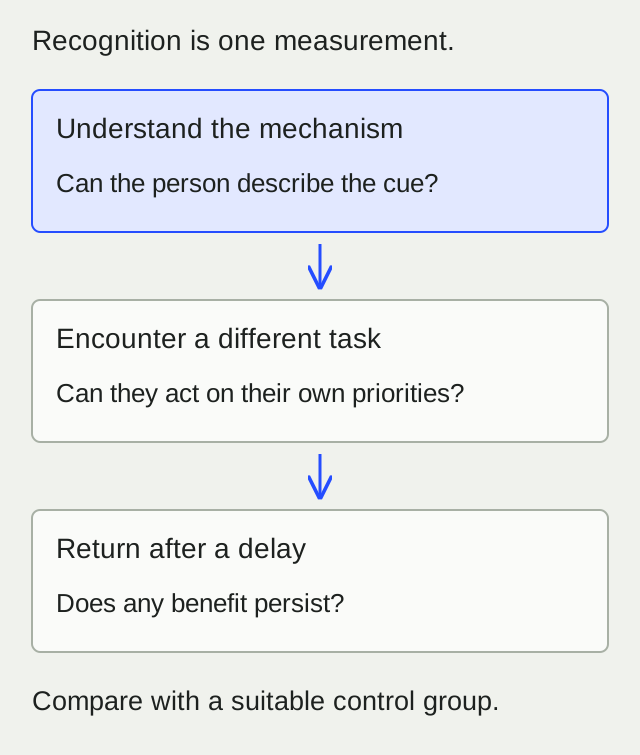
Study anatomy / Explanatory schematic

What would count as protection?

Measure cue recognition, transfer to a new task, and performance after a delay against a suitable comparison group.
A proposed design schematic informed by Morewedge et al.’s training and follow-up research. It describes this project’s open question; it is not a reproduction of their procedure or results. View the source study ↗

Default-disclosure experiment

Bruns et al. (2018) — Can nudges be transparent and yet effective?

In a contribution experiment, explaining a default’s influence or purpose did not reliably eliminate its effect. Disclosure and influence can coexist. That makes this protocol’s central question testable rather than settled: recognising a cue need not remove it, although a null difference does not prove disclosure never matters.

Longitudinal training experiments

Morewedge et al. (2015) — Debiasing Decisions

Game and video interventions reduced several measured biases, with benefits still observed at a later follow-up. Practice and feedback mattered. This offers a constructive direction for the protocol: test transfer to new problems over time, rather than treating an improved immediate replay as evidence that awareness alone protects someone.

A protocol makes the proposed comparison inspectable before data exist. Related findings do not guarantee the planned field study will reproduce them.