Closing reflection / inspired by Mind Field

The human
weight of it.

After asking how influence works, take time to ask what it means for you—and for the person you are about to judge. If you have arrived here first, the research notes and optional demonstrations offer a way into those questions.

Five chapters · two optional demonstrations · take the time you need

Chapter 1 of 5

01 / Social pressure

“I would say
what I see.”

Someone agrees with a group despite having doubts. From the outside, it is easy to ask why they did not simply speak up.

Reflection text stays on this page and is lost when you reload or leave. Nothing is submitted.

The study behind the question

In Asch’s line-judgement studies, a participant heard a unanimous group give incorrect answers. Some answers shifted toward the group; many remained independent. The work makes the social situation part of the explanation, while its historical sample and setting limit what can be generalised.

Asch (1956) — Studies of independence and conformity ↗

Our online popularity demonstration explores a related social cue. It does not recreate the pressure of disagreeing with people in a room.

Explore the popularity cue ↗
Watch alongside this chapterVsauce · Mind Field: Conformity ↗

A viewing companion to the question of group influence.
02 / Introspection

“I know why
I chose that.”

Our reasons help make a decision feel like our own. Begin with a small, fictional choice, then inspect the account that follows it.

Demonstration 011Before you begin

Experience first.

This voluntary demonstration changes how information is presented. Some details, including any simulated claims, are explained after the final step. You can reveal them or leave at any time.

Some on-screen statements may be deliberately inaccurate. Your original response is kept for the reveal.

Your responses stay in this browser tab. No research data is submitted.

Read the mechanism first
Read the research and the human question

Johansson and colleagues sometimes substituted the outcome of a face choice. Participants could give reasons for the substituted outcome without reporting the mismatch. Our notebook adaptation changes the procedure and cannot establish that the same effect occurred in you.

Johansson et al. (2005) — Failure to detect mismatches between intention and outcome ↗

Supermarket choice experiment

Hall et al. (2010) — Magic at the marketplace

The jam-and-tea experiment carries choice blindness into an ordinary shopping setting. Some people explained substituted outcomes without reporting the change. It gives this chapter a practical human question: could a sincere explanation deserve patient checking? It cannot tell us why any particular person acted.

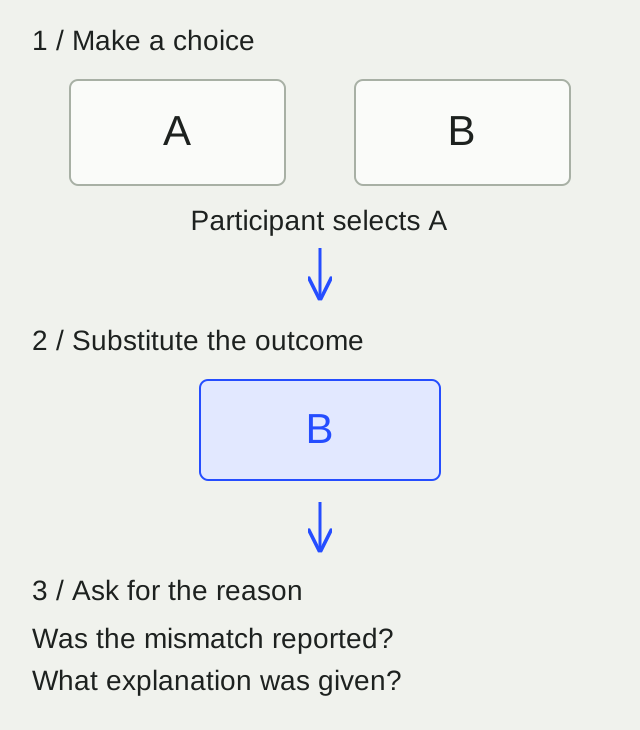
Study anatomy / Explanatory schematic

A choice and its explanation can come apart.

Select A, receive B on a manipulated trial, then explain the outcome. Researchers record whether the mismatch is reported.
An original schematic after Johansson et al. (2005), Figure 1. Lettered cards replace the original face photographs; the concealed switch and subsequent explanation are retained. View the source study ↗

What would change if you treated an explanation as something to understand and check—even when it is offered sincerely?

03 / Recollection

“I remember it
clearly.”

A recollection comes with a feeling. Here, there is also a record you can inspect. Try a short word task before opening the research.

Demonstration 012Before you begin

Experience first.

This voluntary demonstration changes how information is presented. Some details, including any simulated claims, are explained after the final step. You can reveal them or leave at any time.

Your responses stay in this browser tab. No research data is submitted.

Read the mechanism first
Read the research and the human question

The Deese–Roediger–McDermott approach uses related words to study recognition of an associated word that was never presented. Stadler, Roediger, and McDermott published norms for these lists in 1999, following the 1995 experiments. This version uses one self-paced list and different recognition questions.

Stadler, Roediger & McDermott (1999) — Norms for word lists that create false memories ↗

Word-list memory experiments

Roediger & McDermott (1995) — Creating false memories

The original experiments linked related-word learning with confident memory for a word never presented. That makes the distinction between certainty and an inspectable record central to this chapter. A laboratory word error offers no verdict on whether someone’s personal recollection is true.

Study anatomy / Explanatory schematic

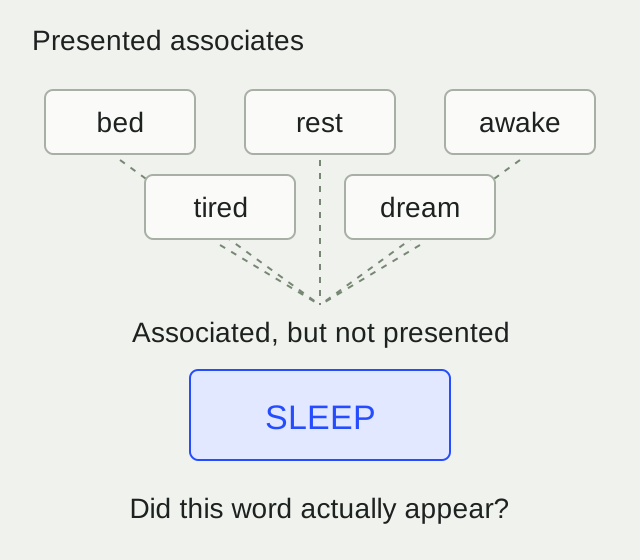
Related is not the same as remembered.

Bed, rest, awake, tired and dream are presented examples. Sleep is their associated word, absent from the list.
An original diagram using five examples from Stadler et al. (1999), Appendix, p. 500. Dashed connections indicate word associations, not measured neural pathways. The full published list contains fifteen associates. View the source study ↗

A word-list result cannot tell us whether a specific personal memory is true. It is a starting point for asking better questions.

When two people remember a conversation differently, what could you check before assuming one is lying?

A wider question about self-knowledgeVsauce · Mind Field: Do You Know Yourself? ↗

A thematic companion; this word task does not reproduce the episode’s procedures.

04 / Agency

“How much of this
was mine?”

Conformity, a substituted choice, an uncertain memory: each can loosen an assumption about how well we understand ourselves. You may feel unsettled, curious, unconvinced, or several things at once.

These demonstrations do not establish that free will is an illusion. They ask narrower questions about social pressure, reported reasons, and recollection. The larger philosophical question remains open.

Believing that people have agency can coexist with asking what shaped the possibilities available to them.

Why the kind of decision matters

In a 2019 EEG study, Maoz and colleagues found a neural signal before arbitrary actions that was absent in their deliberate donation condition. Their result challenges a simple leap from purposeless movements to meaningful decisions. One experiment does not resolve the neuroscience or the philosophy of free will.

Maoz et al. (2019) — Neural precursors of decisions that matter ↗

Default-disclosure experiment

Bruns et al. (2018) — Can nudges be transparent and yet effective?

A disclosed default could still influence contributions in this experiment. Knowing about an influence and being unaffected by it are different questions. This provides a behavioural companion to the chapter’s neuroscience discussion; neither line of work settles whether free will exists.

Watch alongside this chapterVsauce · Mind Field: Freedom of Choice ↗

Continue exploring the question, with the limits of each experiment in view.

05 / Compassion & responsibility

“What might
I be missing?”

Return to the person who stayed silent. You still do not know why. The chapters have invited you to consider the room around a decision, the limits of an explanation, and the evidence behind a memory. What would those questions change about how you approach this person?

Your opening thought

You did not write an opening thought. You can reflect from here.

01

Look for the conditions.

What pressure, uncertainty, dependency, or missing information would you want to understand?

02

Keep the consequences visible.

Who was affected? What responsibility, boundary, or repair is still needed?

03

Make another choice possible.

What support or change in the environment could help next time?

These reflections remain on this page. They are not analysed or added to your demonstration record. Download them if you want to keep them.

What research can offer this reflection

Longitudinal training experiments

Morewedge et al. (2015) — Debiasing Decisions

The training experiments found that some decision biases could be reduced, with benefits at follow-up. They offer a practical reason to ask what support or practice might help someone next time. They did not measure compassion, and this reflection is not an empathy intervention with an established effect.

Understanding what shaped someone’s behaviour can make room for compassion, accountability, and a different next step.

This is the observatory’s invitation to reflection, not a measured outcome of your visit. We do not score empathy or infer that your beliefs have changed.