When the surroundings become part of the thing itself.
Field studyProtocol
A visual encounter / Four settings
One object. Four stories.
Look at the blue object in each setting. What would you call it? Would you pick it up, give it as a gift, or expect to pay for it?
Four AI-created scenes based on the homepage’s blue glass object. An illustration to explore, with no responses collected.
01 / Setting
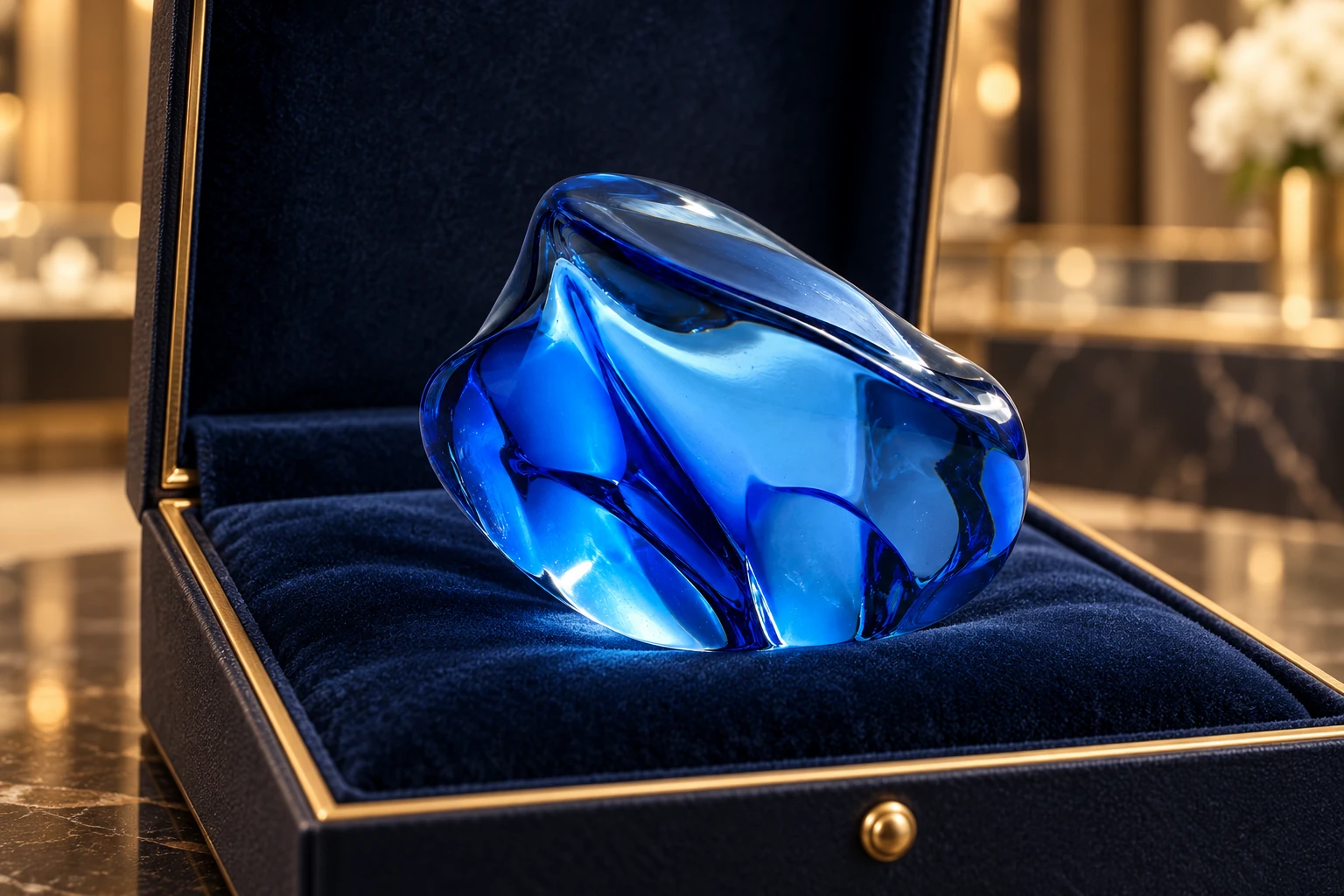
The jeweller’s counter
02 / Setting
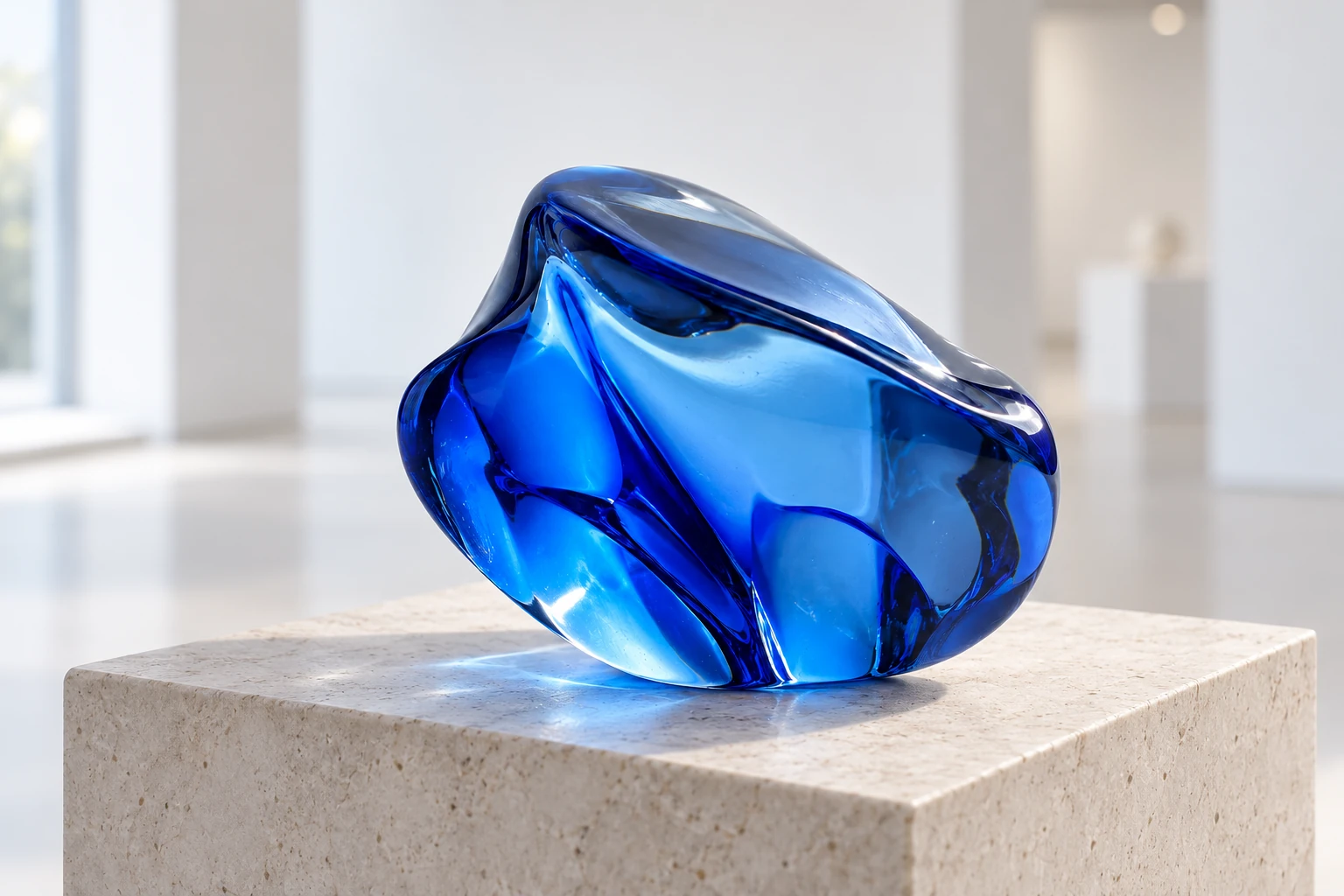
The gallery
03 / Setting
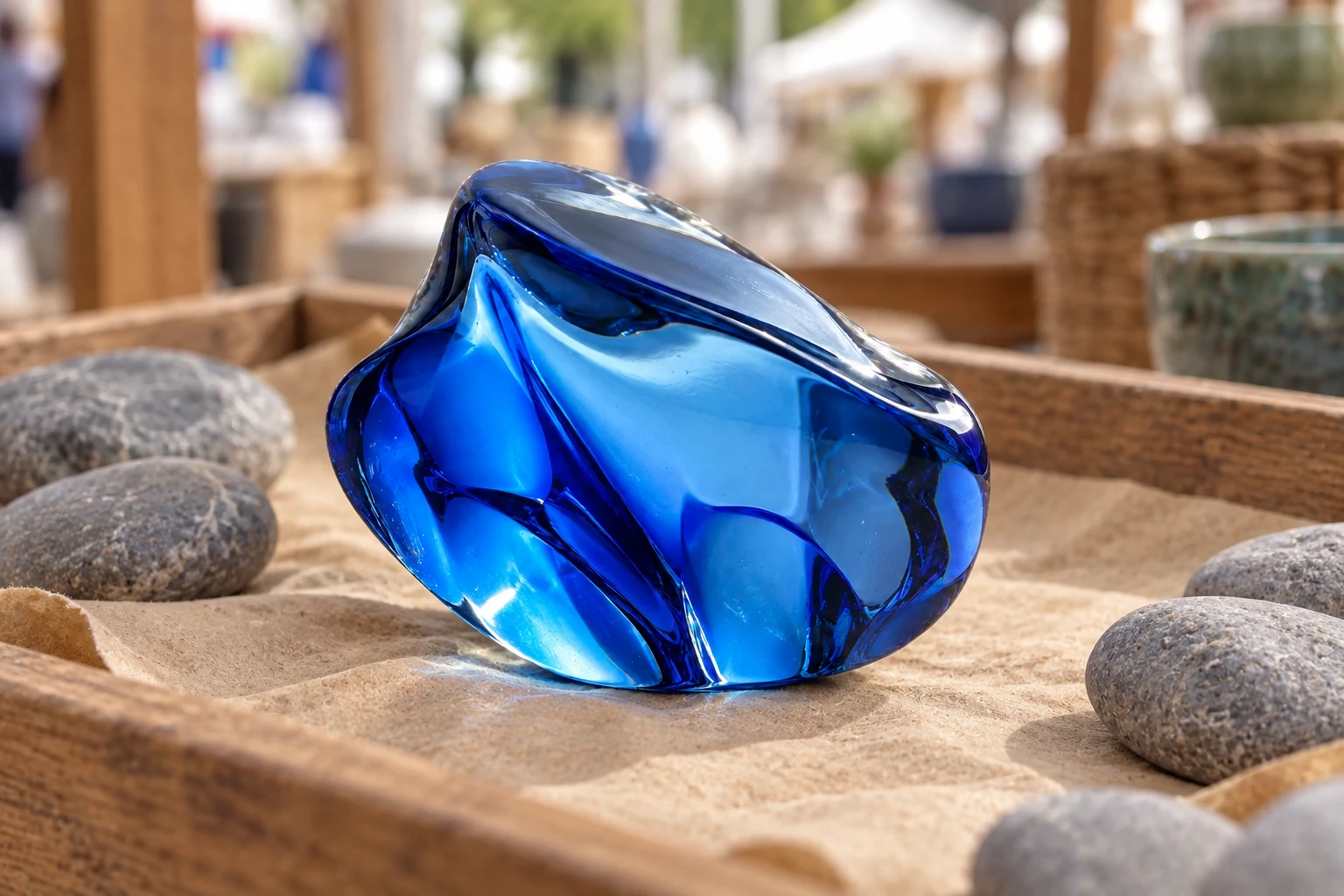
The market stall
04 / Setting
The gravel
At what point did “a piece of glass” start to feel like something else?
Take a second look at the surroundings +
What did the setting suggest?
You may see a precious object, an artwork, a small craft purchase, or an interesting find. You may also see the same piece of glass throughout. There is no correct ranking.
Possible readings of the four settings
Setting
Cues to inspect
A possible inference
Jeweller
Velvet, a presentation box, carefully directed light
Someone has selected and protected this. Perhaps it is precious.
Gallery
A plinth, space around the object, a curated room
Someone considers this worth looking at. Perhaps it has artistic significance.
Market
A simple tray, ordinary materials, nearby objects
This may be a decorative piece or an affordable gift.
Gravel
No display, rough surroundings, no visible seller
This may be a loose pebble or discarded glass—or a lucky find.
The question is whether information about the setting became a belief about the object. A display can offer useful context. It can also invite assumptions about material, rarity, workmanship, or price that still need evidence.
These generated scenes vary lighting, composition, and surroundings together; the object’s rendering can also differ. They cannot isolate an environmental effect or establish a monetary value. The field protocol below describes a more controlled comparison using an actual unchanged object.
Outside these pictures
In a shop, museum, restaurant, or online listing, there may be no second view to compare. Before accepting the setting’s suggestion, ask what you know about the thing itself: its material, provenance, condition, and usefulness to you. Emotional or sentimental value can matter too; it need not be the same as a resale price.
Protocol
A question to investigate.
Use the same object and room. Change one predeclared variable, such as lighting, while keeping placement and instructions fixed. Counterbalance order across consenting participants and record device or room conditions. Compare object ratings and environment ratings separately.
The four generated scenes are a visual illustration based on the homepage object. They are not field observations or a controlled comparison. No participant data have been collected in this implementation.
The full research recordSee the mechanism and the limits.+
Study 006 / The room changes the product
01 / Observation
People encounter an object together with lighting, sound, materials, spacing, and other surroundings.
02 / Hypothesis
Changing one environmental variable may change the rating of an otherwise unchanged object or experience.
03 / Mechanism
Expectation and sensory context are candidate explanations. This protocol does not assume that every sensory intervention produces an effect.
04 / Experiment
Use the same object and room. Change one predeclared variable, such as lighting, while keeping placement and instructions fixed. Counterbalance order across consenting participants and record device or room conditions. Compare object ratings and environment ratings separately.
05 / Result
The four generated scenes are a visual illustration based on the homepage object. They are not field observations or a controlled comparison. No participant data have been collected in this implementation.
06 / Alternative explanations
Adaptation, order, temperature drift, social expectations, visible equipment, or a physical change to the object itself.
07 / Real-world use
Restaurants, retail spaces, packaging displays, museums, listening rooms, and hospitality.
08 / Ethical dimension
Agree the scope of participation before changing the environment. Make the intervention reversible and disclose exactly what changed. Account for sensory comfort and individual access needs.
09 / Countermeasure
Repeat the rating in a neutral setting. Ask separately how the object and the environment felt.
The research behind this page
Short summaries in our own words: what the research found, why it belongs here, and where its conclusions stop. These papers provide background; they do not report results from your visit.
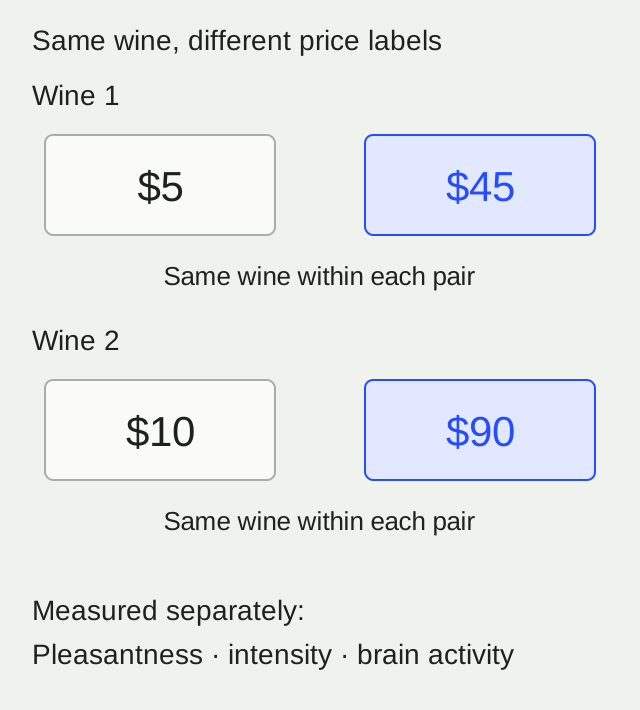
Study anatomy / Explanatory schematic
Separate the object from its context.
Original condition diagram based on Plassmann et al.’s experimental design and the captions to Figures 1–2. Prices are labels used in that experiment. Ratings and brain images are not reproduced. View the source study ↗
Separate groups’ descriptions of wine reflected the emotional character of the music playing while they drank. This directly motivates asking whether a room changes judgements of the object itself. It is evidence about a particular auditory and tasting setup, not proof that the four illustrated displays change anyone’s valuation.
Holding wine constant while varying its stated price helped separate the drink from expectations surrounding it. That is the useful design principle for this field protocol: preserve the actual object and manipulate a defined contextual cue. Our generated scenes change several features together, so they remain an illustration.
A protocol makes the proposed comparison inspectable before data exist. Related findings do not guarantee the planned field study will reproduce them.