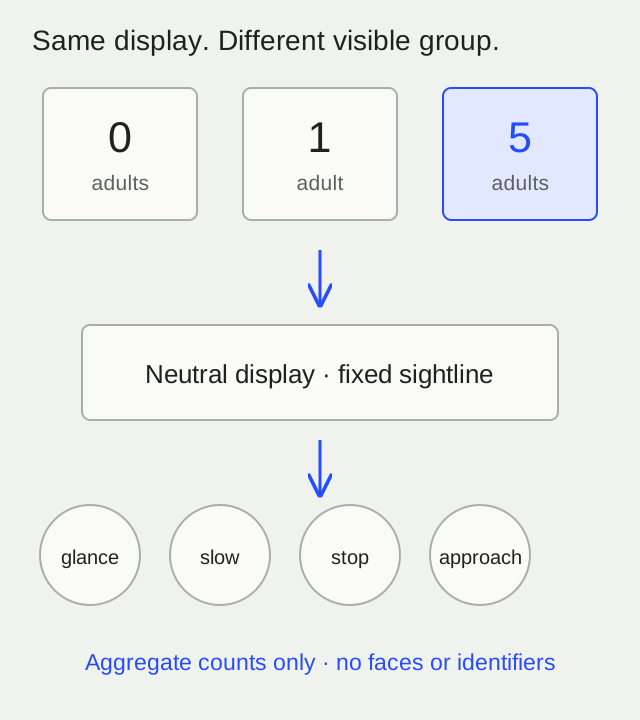
With venue approval, counterbalance blocks using zero, one, and five trained adults who stop at fixed positions and attend to the same neutral display for the same duration. Record aggregate counts of eligible passers-by, glances, slowing, stops, and approaches without faces or identifiers. Keep the display, sightline, actor behaviour, and block length fixed; log weather, local events, pedestrian density, obstructions, and existing queues.
This is a proposed field protocol. No actors have been placed and no public behaviour has been observed. The protocol should be preregistered with safety, stopping, and exclusion rules.
The full research recordSee the mechanism and the limits.+
Study 015 / The crowd that makes a crowd
01 / Observation
A few people who stop and look can become information for everyone approaching after them.
02 / Hypothesis
A larger visible group attending to the same neutral display may increase the proportion of passers-by who glance, slow, stop, or approach.
03 / Mechanism
Social proof, informational uncertainty, imitation, curiosity, and simple visual obstruction are competing explanations. Following a gaze does not establish agreement, desire, or unawareness.
04 / Experiment
With venue approval, counterbalance blocks using zero, one, and five trained adults who stop at fixed positions and attend to the same neutral display for the same duration. Record aggregate counts of eligible passers-by, glances, slowing, stops, and approaches without faces or identifiers. Keep the display, sightline, actor behaviour, and block length fixed; log weather, local events, pedestrian density, obstructions, and existing queues.
05 / Result
This is a proposed field protocol. No actors have been placed and no public behaviour has been observed. The protocol should be preregistered with safety, stopping, and exclusion rules.
06 / Alternative explanations
A larger group is more visually salient, blocks the path, creates sound, signals a queue, or makes the display harder to see. Time, events, weather, and pedestrian composition can also change stopping.
07 / Real-world use
Shop windows, street performances, restaurant queues, trade-show booths, viewing counters, livestream audiences, trending lists, and visible engagement metrics.
08 / Ethical dimension
Do not obstruct paths, manufacture demand for a real transaction, create alarm, record identifiable people, or include minors in analysis. Use a neutral setting, short blocks, venue approval, public notice or debrief where feasible, and an immediate stop rule for congestion or distress.
09 / Countermeasure
Ask what drew the first people and whether the crowd supplies evidence about the thing itself. Inspect the object or claim separately from the number of people attending to it.
The research behind this page
Short summaries in our own words: what the research found, why it belongs here, and where its conclusions stop. These papers provide background; they do not report results from your visit.
Study anatomy / Explanatory schematic
When attention becomes part of the scene.
An original schematic of the proposed protocol, informed by Milgram and colleagues’ street experiment. It depicts planned conditions, not an effect size. View the source study ↗
On a busy street, Milgram and colleagues varied the size of a group looking upward and recorded whether passers-by adopted the looking behaviour. Larger groups drew more looking in that setting. The procedure supports a crowd-size comparison, not a claim that every crowd signals value or forces conformity.
In an online music market, showing other people’s downloads made success more unequal and less predictable. It provides a digital counterpart to a street crowd: visible attention can help produce the popularity it appears to report, while the underlying songs still mattered.
A protocol makes the proposed comparison inspectable before data exist. Related findings do not guarantee the planned field study will reproduce them.