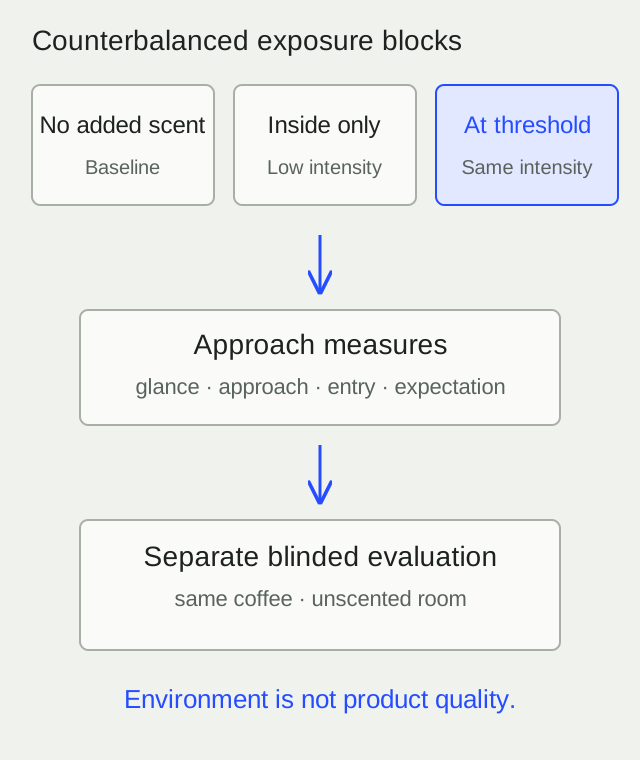
Counterbalance matched time blocks with no added scent, a low-intensity scent inside only, and the same scent at the threshold. Keep the menu, prices, signage, staffing, music, lighting, and coffee-production schedule fixed. Pretest perceived intensity; log weather, wind, doors, queues, footfall, and ventilation. Count passers-by, glances, approaches, and entries in aggregate. With consent, ask a separate intercept sample about expected quality and desire before ordering. In an unscented room, let a blinded panel evaluate the same standardised coffee so approach and expectation are not mistaken for product quality.
This is a proposed field protocol. No scent has been dispersed and no observations have been collected. The design must be reviewed with the venue, staff, safety specialists, and an appropriate ethics process before use.
The full research recordSee the mechanism and the limits.+
Study 013 / The scent before the cup
01 / Observation
Coffee aroma can cross a shop boundary before someone decides to approach, enter, order, or taste anything.
02 / Hypothesis
A controlled coffee-like ambient scent at the entrance may change noticing, approach, entry, or expected quality even when the coffee, menu, service, and visible shop remain unchanged.
03 / Mechanism
Learned associations, expectation, appetite, and arousal are candidate explanations. The protocol does not assume the scent is unnoticed, that the effect is nonconscious, or that a stronger smell is better.
04 / Experiment
Counterbalance matched time blocks with no added scent, a low-intensity scent inside only, and the same scent at the threshold. Keep the menu, prices, signage, staffing, music, lighting, and coffee-production schedule fixed. Pretest perceived intensity; log weather, wind, doors, queues, footfall, and ventilation. Count passers-by, glances, approaches, and entries in aggregate. With consent, ask a separate intercept sample about expected quality and desire before ordering. In an unscented room, let a blinded panel evaluate the same standardised coffee so approach and expectation are not mistaken for product quality.
05 / Result
This is a proposed field protocol. No scent has been dispersed and no observations have been collected. The design must be reviewed with the venue, staff, safety specialists, and an appropriate ethics process before use.
06 / Alternative explanations
Natural brewing or bakery aromas, wind and ventilation, weather, time of day, caffeine demand, regular customers, visible queues, promotions, staff behaviour, and changing pedestrian traffic could explain a difference. Unstable scent plumes and unmatched blocks should be excluded under predeclared rules.
07 / Real-world use
Coffee shops, bakeries, hotel lobbies, food halls, transport hubs, retail entrances, and scent-enabled advertising.
08 / Ethical dimension
Ambient scent can affect people who never chose to enter. Use ingredients and exposure levels reviewed for public settings; account for asthma, migraine, pregnancy, sensory sensitivity, staff exposure, and nearby businesses. Avoid individual tracking, prevent nuisance outside the agreed boundary, and disclose and debrief where practicable.
09 / Countermeasure
Step outside the scented zone before deciding. Separate “this smells inviting” from “this product meets my criteria,” and, where it matters, compare the product blind or against independent evidence.
The research behind this page
Short summaries in our own words: what the research found, why it belongs here, and where its conclusions stop. These papers provide background; they do not report results from your visit.
Study anatomy / Explanatory schematic
Separate the scent from the cup.
An original schematic of the proposed protocol. It separates environmental exposure, approach behaviour, expectation, and product evaluation. It contains no results. View the source study ↗
In simulated retail environments, participants evaluated scented and unscented settings differently. The study makes ambient odour a legitimate variable to isolate, but it did not test a real coffee-shop threshold or prove that scent improves purchases or product quality.
A coffee-like scent changed expectations and analytical-task performance in the reported experiments. That coffee-specific association is relevant before a cup is tasted; it is not evidence that doorway scent causes entry, improves flavour, or operates outside awareness.
Controlled field work in a shopping centre produced a more qualified picture, including limited or absent behavioural effects under stronger controls. This belongs beside the positive findings because scent is not a dependable lever in every environment and field confounds can create an appealing story.
A protocol makes the proposed comparison inspectable before data exist. Related findings do not guarantee the planned field study will reproduce them.