A room can change pace without giving an instruction.
Field studyProtocol
Protocol
A question to investigate.
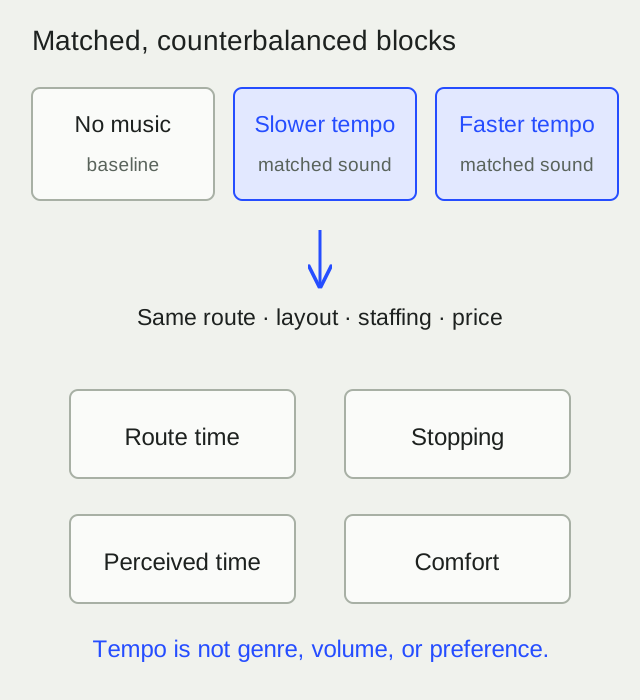
Counterbalance no-music, slower-tempo, and faster-tempo blocks across comparable periods. Match loudness, genre, familiarity, valence, track duration, and playback location as closely as possible; where feasible use tempo-adjusted versions of the same material. Hold staffing, queue system, layout, pricing, and promotions fixed. Record aggregate route time and stopping, plus consenting participants’ perceived duration and comfort. Log footfall, time, events, and operational changes before analysing.
This is a proposed field protocol with no observations. It does not predict that fast music always speeds people up or that longer dwell necessarily benefits the visitor or venue.
The full research recordSee the mechanism and the limits.+
Study 014 / The tempo in the aisle
01 / Observation
Background music changes over time while people move, wait, browse, and estimate how long an experience has taken.
02 / Hypothesis
Music tempo may change walking pace, dwell time, perceived duration, or abandonment while leaving the route and available products unchanged.
03 / Mechanism
Rhythmic entrainment, arousal, attention, and mood are candidate explanations. Tempo is not interchangeable with genre, familiarity, preference, volume, or musical fit.
04 / Experiment
Counterbalance no-music, slower-tempo, and faster-tempo blocks across comparable periods. Match loudness, genre, familiarity, valence, track duration, and playback location as closely as possible; where feasible use tempo-adjusted versions of the same material. Hold staffing, queue system, layout, pricing, and promotions fixed. Record aggregate route time and stopping, plus consenting participants’ perceived duration and comfort. Log footfall, time, events, and operational changes before analysing.
05 / Result
This is a proposed field protocol with no observations. It does not predict that fast music always speeds people up or that longer dwell necessarily benefits the visitor or venue.
06 / Alternative explanations
Crowding, queues, staff pace, shopping purpose, age, mobility, hearing, music preference, promotions, weather, and time of day may change movement or duration independently of tempo.
07 / Real-world use
Supermarkets, restaurants, gyms, casinos, waiting rooms, exhibitions, public transport, and hospitality spaces.
08 / Ethical dimension
Keep volume and repetition within comfortable limits, provide quieter routes or times, include staff consent and exposure, and treat accessibility and sensory needs as design requirements rather than noise in the data.
09 / Countermeasure
Notice the soundtrack and check elapsed time against a clock. Set a route, budget, or stopping rule before entering when pace and duration matter.
The research behind this page
Short summaries in our own words: what the research found, why it belongs here, and where its conclusions stop. These papers provide background; they do not report results from your visit.
Study anatomy / Explanatory schematic
Change tempo. Hold the route still.
An original schematic of the proposed protocol. The conditions and outcome measures are plans, not observations. View the source study ↗
In a supermarket field experiment, background-music tempo was associated with changes in traffic pace and sales volume. It motivates measuring movement in place, but one store study does not establish a universal tempo effect or separate every feature of the music and shopping day.
Music playing during wine tasting changed how separate groups described the wine in this experiment. That result broadens the protocol beyond walking speed: sound may alter the experience people attribute to an object. It does not show that tempo alone caused those ratings.
A protocol makes the proposed comparison inspectable before data exist. Related findings do not guarantee the planned field study will reproduce them.