← Back to study collection

Study 012 / memory

A short word list

Read a list, then answer a few questions.

DemonstrationReady to try
Demonstration 012Before you begin

Experience first.

This voluntary demonstration changes how information is presented. Some details, including any simulated claims, are explained after the final step. You can reveal them or leave at any time.

Your responses stay in this browser tab. No research data is submitted.

Read the mechanism first
The full research recordSee the mechanism and the limits.

Study 012 / The word that wasn’t there

01 / Observation

Related words can bring an associated word to mind even when that word was absent from the list.

02 / Hypothesis

The unpresented word “sleep” may be recognised as present after reading words associated with it.

03 / Mechanism

Related meanings can activate an absent word; remembering the theme may be confused with remembering a particular item. Several accounts of the DRM effect exist.

04 / Experiment

Read a related-word list at your own pace, hide it, then judge six words as present, absent, or uncertain. The recognition-question order varies between visits and is preserved in replay. Inspect the exact list afterward. The informed replay leaves the list available as an external record.

05 / Result

The reveal compares each answer with the actual list and preserves uncertainty. Recognising an absent word is an error on this task; neither an error nor a correct answer establishes your general memory reliability.

06 / Alternative explanations

Prior knowledge, reading time, guessing, language familiarity, distraction, and the study title can all affect the response. Self-paced text, one list, and immediate testing differ from the published procedure.

07 / Real-world use

An invitation to check notes and ask open questions when recollections differ. Word-list findings cannot determine whether any particular autobiographical memory or testimony is accurate.

08 / Ethical dimension

This uses ordinary words and does not ask you to recover or reinterpret a personal event. A disagreement with the list is shown without shaming or a diagnostic label.

09 / Countermeasure

Compare recollection with an independent record when one exists. In the replay, consult the list. That illustrates a practical support; it does not test whether awareness alone protects memory.

The research behind this page

Short summaries in our own words: what the research found, why it belongs here, and where its conclusions stop. These papers provide background; they do not report results from your visit.

Study anatomy / Explanatory schematic

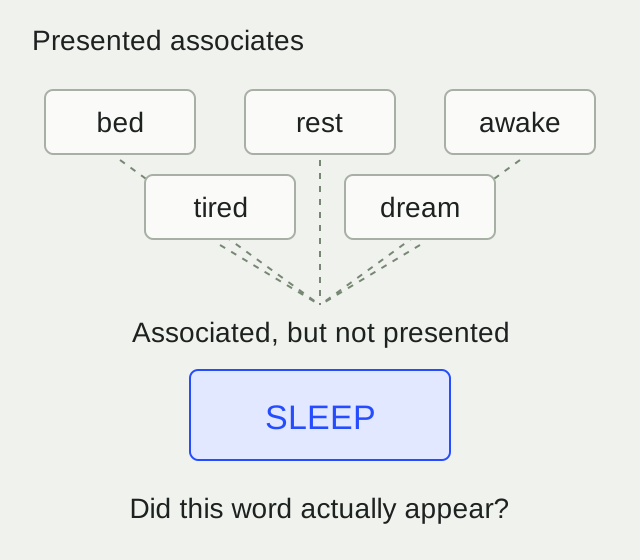
Related is not the same as remembered.

Bed, rest, awake, tired and dream are presented examples. Sleep is their associated word, absent from the list.
An original diagram using five examples from Stadler et al. (1999), Appendix, p. 500. Dashed connections indicate word associations, not measured neural pathways. The full published list contains fifteen associates. View the source study ↗

Word-list memory experiments

Roediger & McDermott (1995) — Creating false memories

In two experiments, studying related words led people to recall or recognise an associated word that had not appeared. Confidence could accompany the error. The significance here is that a feeling of remembering can be checked against a presentation record; this result does not adjudicate a particular autobiographical memory.

A demonstration can make a mechanism inspectable. One person’s response, or a replay after disclosure, cannot identify a causal effect or establish nonconscious influence.