← Back to study collection

Study 003 / attention

Two research notes

Choose what you would open in two short rounds.

DemonstrationReady to try
Demonstration 003Before you begin

Experience first.

Make two quick choices, then see both presentations together.

This voluntary demonstration changes how information is presented. Some details, including any simulated claims, are explained after the final step. You can reveal them or leave at any time.

Your responses stay in this browser tab. No research data is submitted.

Read the mechanism first
The full research recordSee the mechanism and the limits.

Study 003 / Where did you look?

01 / Observation

Two research notes with equivalent descriptions and differently phrased titles can receive very different visual emphasis.

02 / Hypothesis

A more visually prominent option may be selected or recalled more often.

03 / Mechanism

Contrast can contribute to salience, alongside task goals, expectations, position, and meaning.

04 / Experiment

Choose a research card in two consecutive presentations. The first highlights one card; the second gives both equal emphasis. Each choice advances automatically. The titles use different phrasing for the same topic, with the same description and reading time. Titles and card order stay fixed across both rounds and replay. Optional recall follows both choices, then one reveal compares them.

05 / Result

The reveal preserves both choices and optional recall. It does not know where your eyes looked or whether emphasis caused a decision. A second response is not an independent control observation.

06 / Alternative explanations

Preference for one title’s phrasing, reading order, colour preference, chance, remembering the first choice, seeking consistency, noticing the contrast, or guessing the hypothesis. The titles are intended to have similar appeal, but that equivalence has not been measured. The fixed sequence cannot isolate an emphasis effect.

07 / Real-world use

Supermarket shelves, streaming rows, news pages, app stores, and checkout actions.

08 / Ethical dimension

Visual emphasis can support a person’s task or steer them toward another party’s objective. Visibility of alternatives and freedom to choose remain relevant.

09 / Countermeasure

Equalise the presentation and compare the underlying descriptions. Replay after disclosure cannot establish that awareness has made you immune.

The research behind this page

Short summaries in our own words: what the research found, why it belongs here, and where its conclusions stop. These papers provide background; they do not report results from your visit.

Study anatomy / Explanatory schematic

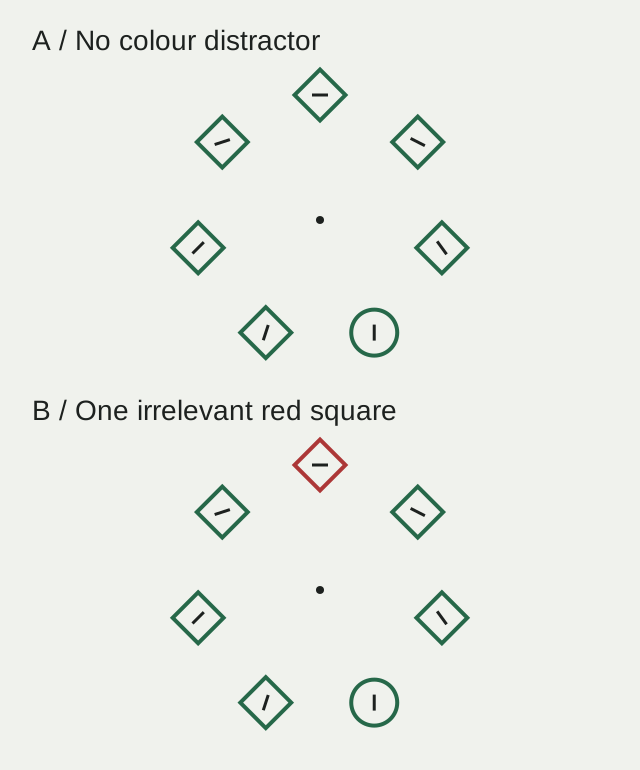
A conspicuous feature can compete with a goal.

Two search arrays contain one green circle among squares. Only the second array includes an irrelevant red square.
Reconstructed from the form-search conditions in Theeuwes (1992), Figure 1. Find the green circle and report its internal line orientation. Positions are illustrative; no response-time results are plotted. View the source study ↗

Primary research

Itti & Koch (2000) — A saliency-based search mechanism

Itti and Koch modelled how visual features can contribute to the selection of conspicuous locations. The model helps explain why contrast is a candidate influence on these cards. It does not tell us where a visitor looked: a click or recalled headline is not an eye-movement measurement.

Visual-search experiments

Theeuwes (1992) — Perceptual selectivity for color and form

In a controlled visual-search task, an irrelevant colour singleton slowed some searches for a shape target. The relative distinctiveness of colour and form mattered. This gives a more precise basis for the emphasis comparison: conspicuous information can compete with the task, but a bright element does not invariably win attention.

A demonstration can make a mechanism inspectable. One person’s response, or a replay after disclosure, cannot identify a causal effect or establish nonconscious influence.