← Back to study collection

Study 002 / perception

Four price offers

Judge four offers, then compare your responses.

DemonstrationReady to try
Demonstration 002Before you begin

Four offers. Your judgement.

Rate four offers, one at a time. See all your responses together before exploring the explanation.

This voluntary demonstration changes how information is presented. Some details, including any simulated claims, are explained after the final step. You can reveal them or leave at any time.

Your responses stay in this browser tab. No research data is submitted.

Read the mechanism first
The full research recordSee the mechanism and the limits.

Study 002 / The price that changes nothing

01 / Observation

A price can be accompanied by a crossed-out reference, a popularity badge, or a stock message.

02 / Hypothesis

Changing only this surrounding claim may change stated value, urgency, or confidence.

03 / Mechanism

A reference price supplies a comparison point. Scarcity and popularity are different candidate mechanisms and are presented as separate variants.

04 / Experiment

Judge four offers one at a time: a crossed-out €79 reference beside €29 first, then a popularity badge, a stock claim, and finally €29 alone. Give value, urgency, and confidence ratings for each before the explanation. The notebook and €29 price stay the same. The replay removes all surrounding claims from four offers.

05 / Result

The reveal compares all submitted ratings with the exact offer shown. Differences or identical ratings describe this visit; they do not establish an effect or immunity. An early reveal preserves completed ratings and marks unrated offers explicitly.

06 / Alternative explanations

Order, repeated exposure to the notebook, remembering earlier ratings, suspicion, prior prices, the study title, and expectations about the task may affect the comparison. The fixed order cannot isolate a causal effect within one visit. Starting with promoted offers is a presentation choice; we have not established that it delays recognition of the pattern.

07 / Real-world use

Retail labels, sale pages, restaurant menus, travel listings, and subscription comparisons.

08 / Ethical dimension

The price reference, stock claim, and popularity label are invented within this disclosed demonstration. In ordinary commerce, their truth and relevance are central to judging the intervention.

09 / Countermeasure

Cover the reference and badges. Decide what the object is worth for your purpose before comparing offers.

The research behind this page

Short summaries in our own words: what the research found, why it belongs here, and where its conclusions stop. These papers provide background; they do not report results from your visit.

Study anatomy / Explanatory schematic

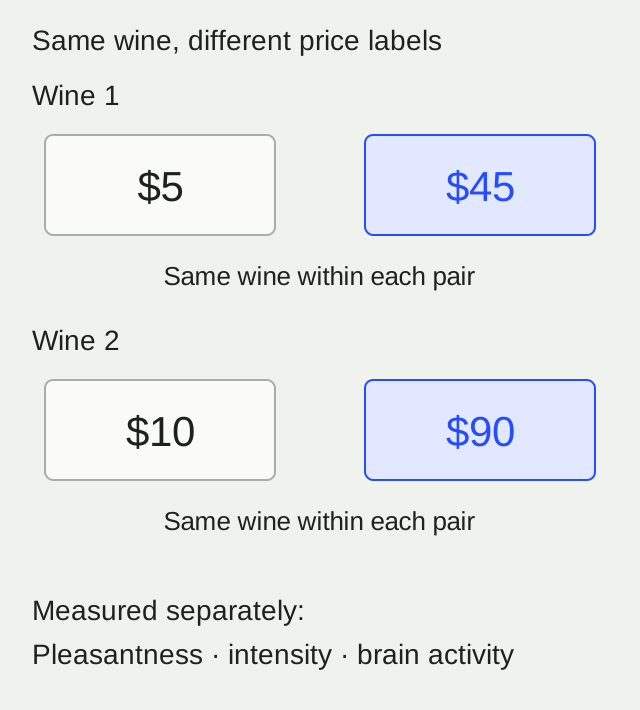
The label changed. The wine did not.

Wine 1 labelled $5 or $45; wine 2 labelled $10 or $90. The wine stays constant within each pair.
Original condition diagram based on Plassmann et al.’s experimental design and the captions to Figures 1–2. Prices are labels used in that experiment. Ratings and brain images are not reproduced. View the source study ↗

Primary research

Tversky & Kahneman (1974) — Judgment under Uncertainty

Tversky and Kahneman described how an initial reference can influence later estimates. A crossed-out price gives the notebook just such a comparison point. This is the background for the anchoring question; the paper does not validate our particular discount, stock message, or popularity badge.

Valuation experiments

Ariely, Loewenstein & Prelec (2003) — Coherent Arbitrariness

These experiments found that arbitrary starting points could influence initial valuations even when later choices followed a coherent pattern. That matters when several offers feel consistently judged: consistency alone does not show that the reference point was irrelevant. Their procedures differ from the fixed sequence of offers here.

A demonstration can make a mechanism inspectable. One person’s response, or a replay after disclosure, cannot identify a causal effect or establish nonconscious influence.