← Back to study collection

Study 001 / choice

Choose your reading rhythm

Make two small choices, then look back at them.

DemonstrationReady to try
Demonstration 001Before you begin

Experience first.

Make two choices, then compare your responses.

This voluntary demonstration changes how information is presented. Some details, including any simulated claims, are explained after the final step. You can reveal them or leave at any time.

Your responses stay in this browser tab. No research data is submitted.

Read the mechanism first
The full research recordSee the mechanism and the limits.

Study 001 / The invisible default

01 / Observation

A preference screen can arrive with one answer already selected.

02 / Hypothesis

A preselected option may be retained more often than an option that requires an explicit selection.

03 / Mechanism

Defaults may communicate a suggested norm, reduce effort, or go unnoticed. Those are competing explanations, not interchangeable conclusions.

04 / Experiment

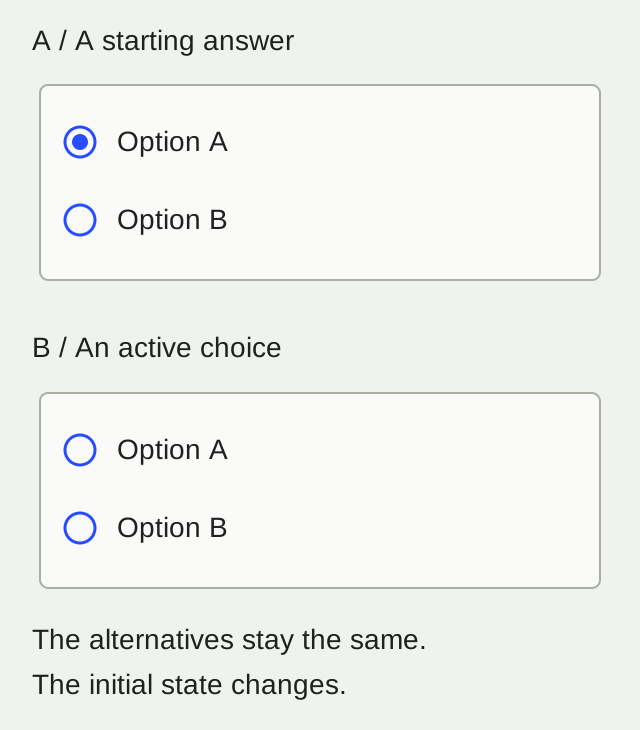
Choose a reading cadence twice before the reveal. The first screen preselects one option; the second leaves both unselected, with the same wording and order. The cadence order varies between visits and stays fixed throughout the comparison and replay. The informed replay leaves both rounds unselected.

05 / Result

The reveal compares both selections and whether the initial default was retained. This is a within-visit comparison, not a control-group experiment. There are no pooled results.

06 / Alternative explanations

You may prefer that cadence, remember your first answer, seek consistency, notice the presentation change, or recognise the premise. Fixed order and repetition prevent attributing a difference to the default alone.

07 / Real-world use

Account preferences, checkout options, cookie interfaces, and enrolment forms.

08 / Ethical dimension

A default can reduce effort or take advantage of inattention. Who benefits, what the choice commits someone to, and how easy it is to change all matter.

09 / Countermeasure

Clear the initial selection. State your preference before viewing the interface. Compare the options with equal effort.

The research behind this page

Short summaries in our own words: what the research found, why it belongs here, and where its conclusions stop. These papers provide background; they do not report results from your visit.

Study anatomy / Explanatory schematic

The decision before the click

The same two options shown with A preselected, then with neither selected.
An original schematic of this demonstration, informed by the default literature. It shows starting states, not participant outcomes. View the source study ↗

Primary research

Johnson & Goldstein (2003) — Do Defaults Save Lives?

Donation choices differed with the starting condition in Johnson and Goldstein’s studies. This makes the preselected answer here worth inspecting: leaving a setting alone can itself determine an outcome. The paper concerns donation agreement, not proof that this fictional reading preference—or actual transplant outcomes—will change.

Meta-analysis

Jachimowicz et al. (2019) — When and why defaults influence decisions

Across 58 studies, defaults generally shifted choices, but their effects varied substantially. The review considers perceived endorsement and the status quo among the explanations. It supports asking why a starting state matters here, while cautioning against treating every retained default as inattention or predicting an individual response.

A demonstration can make a mechanism inspectable. One person’s response, or a replay after disclosure, cannot identify a causal effect or establish nonconscious influence.