← Back to study collection

Study 011 / choice

A notebook for your thoughts

Choose a notebook and tell us a little more.

DemonstrationReady to try
Demonstration 011Before you begin

Experience first.

This voluntary demonstration changes how information is presented. Some details, including any simulated claims, are explained after the final step. You can reveal them or leave at any time.

Some on-screen statements may be deliberately inaccurate. Your original response is kept for the reveal.

Your responses stay in this browser tab. No research data is submitted.

Read the mechanism first
The full research recordSee the mechanism and the limits.

Study 011 / The reason after the choice

01 / Observation

An account of a choice can sound coherent even when the outcome being explained has been changed.

02 / Hypothesis

A participant may offer a reason for the displayed notebook without reporting that it differs from the notebook they selected.

03 / Mechanism

Choice blindness describes failures to detect a mismatch between a choice and its presented outcome. A fluent explanation need not give direct access to how the original choice was made.

04 / Experiment

Choose between two notebooks. The next screen deliberately presents the other one as your choice. You can flag the mismatch immediately or continue with an optional explanation. The replay keeps the actual selection.

05 / Result

The record preserves your original selection, the displayed outcome, and whether you used the mismatch button. Not using that button does not establish that you failed to notice. Your explanation is not analysed.

06 / Alternative explanations

You may notice but play along, misclick, have little preference, recognise the premise, or read the title before starting. This single browser task is not a replication of the face-choice experiment.

07 / Real-world use

Use this question when reviewing a decision summary, a recommendation, or an account of why something happened. These are reflection contexts, not outcomes established by this task.

08 / Ethical dimension

An interface must not rewrite a consequential decision. This disclosed, fictional demonstration changes no purchase or preference outside the task and shows the original selection in its reveal.

09 / Countermeasure

Keep an independent record of the decision and compare it with the outcome before explaining it. A plausible reason deserves the same scrutiny as an implausible one.

The research behind this page

Short summaries in our own words: what the research found, why it belongs here, and where its conclusions stop. These papers provide background; they do not report results from your visit.

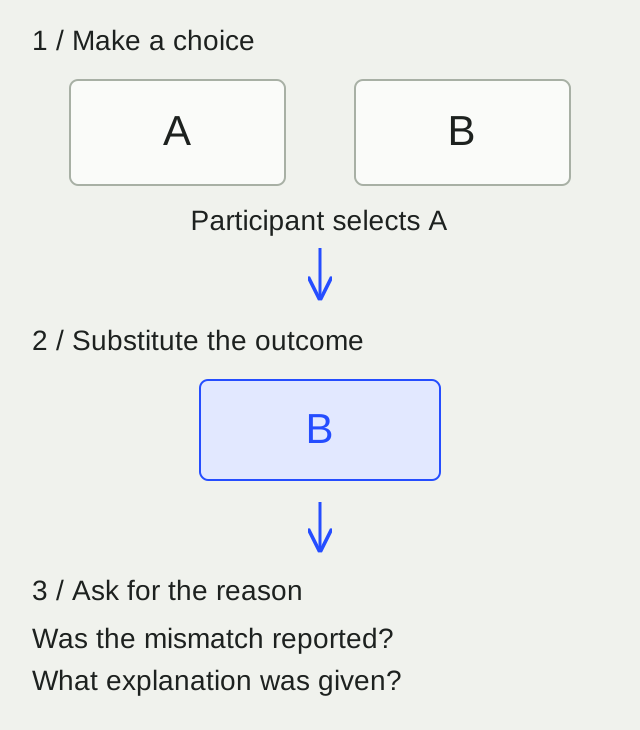
Study anatomy / Explanatory schematic

A choice and its explanation can come apart.

Select A, receive B on a manipulated trial, then explain the outcome. Researchers record whether the mismatch is reported.
An original schematic after Johansson et al. (2005), Figure 1. Lettered cards replace the original face photographs; the concealed switch and subsequent explanation are retained. View the source study ↗

Primary research

Johansson et al. (2005) — Failure to detect mismatches between intention and outcome

Participants sometimes explained a face they had been handed after a concealed switch, without reporting that it differed from their choice. The result separates a fluent explanation from reliable access to the original decision. Our disclosed notebook adaptation changes the stakes, materials, and procedure and cannot diagnose anyone’s self-knowledge.

Supermarket choice experiment

Hall et al. (2010) — Magic at the marketplace

In a supermarket task, people chose between jams or teas before the experimenters sometimes substituted the outcome. Some substitutions went unreported when people sampled and explained the supposed choice. This extends the question beyond portraits into everyday sensory preferences; it does not mean people never notice a mismatch.

A demonstration can make a mechanism inspectable. One person’s response, or a replay after disclosure, cannot identify a causal effect or establish nonconscious influence.